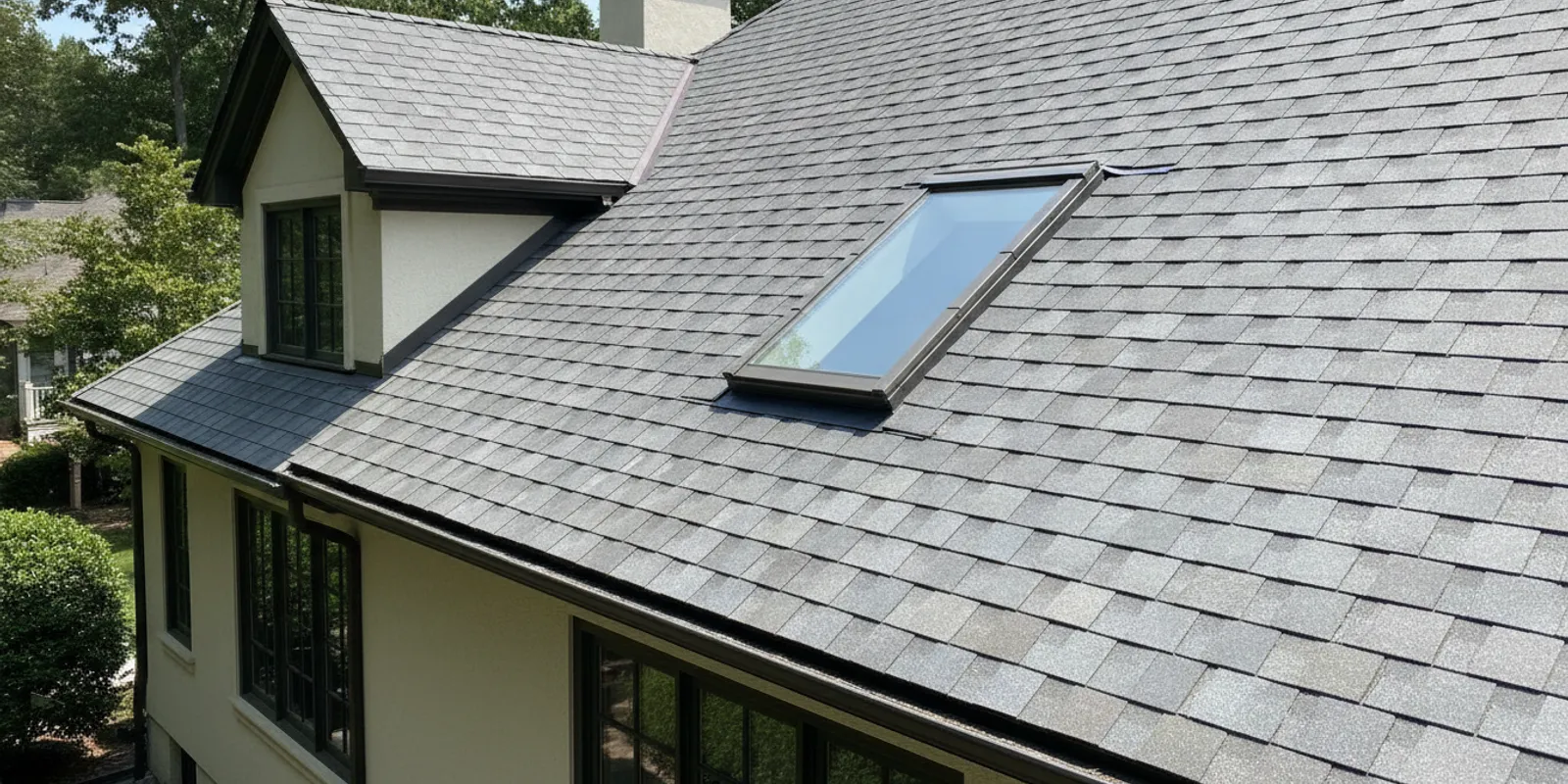
When you search for skylight flashing repair cost, the useful first question is not simply what a repair should cost. It is what is letting water in, how much of the roof assembly is affected, and whether the proposed work corrects that cause. For Charlotte-area homeowners, a clear scope matters because a small-looking stain can come from several different roof details.
Request an Exclusive Roof Inspection
There is no reliable one-size price for skylight flashing work. The visible flashing is only one part of a water-management system. A contractor may need to inspect the skylight frame, roof covering, underlayment, surrounding deck, curb or mounting arrangement, and the interior symptoms before deciding what work is appropriate. Two homes with similar-looking water marks can need very different scopes.
One case may involve a localized flashing detail that has separated or been damaged, while the roof covering and surrounding materials remain sound. Another may involve deteriorated shingles, a compromised deck, an older skylight, or water that has traveled from a different roof feature. The repair process, labor, materials, access, and risk of concealed damage change accordingly.
That is why a useful estimate should explain the observed condition and proposed repair rather than offer a bare number. Ask what will be removed, what will be examined once opened, which materials will be replaced, how the repair will tie into the existing roof, and what findings could change the scope. The answer helps you understand the work before comparing totals.
For a Charlotte property, local conditions also matter to the inspection. Repeated rain, seasonal wind, intense sun, and roof debris can all affect exposed roof details over time. That does not mean any particular storm caused a leak; it means the contractor should look at the actual evidence and distinguish a failed flashing detail from other possible entry points.
Flashing is the formed or layered material around a roof opening that directs water away from vulnerable joints and back onto the roof drainage surface. A skylight interrupts the continuous roof covering. The flashing system helps manage that transition, including where the skylight meets the shingles or other roof material and where water flows around the unit.
Many skylights use a combination of a frame or curb, manufacturer-specific flashing components, underlayment, and roofing materials. Exact configurations differ by skylight model, roof pitch, roof covering, and installation method. A contractor should identify the existing arrangement rather than assume that one universal kit or repair method is suitable.
The visible edge is not always the whole problem. Water can enter above the skylight, travel beneath roofing layers, and show up at an interior corner some distance away. Condensation, a failed seal at the glass or frame, and a roof leak can also leave similar marks indoors. A careful diagnosis separates those possibilities before the repair is priced.
Flashing must work with the roof, not merely cover an exposed line. Applying surface material over a joint without correcting the underlying path can conceal symptoms temporarily while leaving the cause in place. The goal is a properly integrated repair that restores the relevant roof layers and routes water outward.
A useful evaluation begins with the reported symptoms and the roof area around the skylight. Tell the roofer when the leak appears, whether it follows wind-driven rain or ordinary rainfall, whether it happens only during certain weather, and where you see staining or moisture indoors. Note whether the skylight has been replaced, repaired, or disturbed during other roof work, if you know.
The exterior review should include the visible skylight perimeter and the surrounding roof surface. A roofer may look for displaced or damaged shingles, lifted edges, exposed fasteners, failed or incomplete flashing transitions, debris that redirects water, and signs that water has moved beneath the roof covering. The inspection should also consider nearby roof penetrations, valleys, ridges, walls, or other details that could be mistaken for a skylight leak.
Interior observations matter, too. The room side may show staining, damp drywall, bubbling paint, or signs of condensation. Those clues help locate the problem, but they do not prove where water entered. If safe access is available, an attic or roof cavity review may show water tracks or damaged materials; the absence of a visible track does not automatically rule out an intermittent leak.
Ask whether the estimate is based on a visual inspection only or includes opening a portion of the roof. In some cases, the contractor cannot confirm concealed conditions until affected materials are removed. A responsible scope can state what is known now, what will be checked during the work, and how any additional damage will be documented and approved before the plan changes.
Super Roofing describes its inspection process as evaluating the roof and documenting findings. Read about its roof inspection process to understand how an inspection can inform the next step. An inspection is a diagnostic starting point; it does not guarantee that hidden conditions will be visible before materials are opened.
The estimate should identify what is wrong with the flashing, not just say that it needs attention. Relevant details may include a displaced component, damage, an incomplete transition, corrosion, an incompatible installation, or a poor connection between flashing and roof covering. The contractor should explain which components need replacement and why, including whether the skylight manufacturer’s components are available and appropriate for the existing unit.
If an earlier repair added sealant or roofing cement, ask whether it is part of the current failure. A new layer over an old repair does not establish that water will be redirected properly. The scope should say whether the existing material must be removed to inspect the joint and rebuild the affected detail.
Shingles or other roof materials may need to be lifted or removed so the roofer can reach and rebuild the flashing area. Their age and condition influence how the repair can be tied into the roof. Brittle or deteriorated materials can be more difficult to handle without breakage, while an older covering may make matching the appearance challenging.
Ask whether the work includes replacement of adjacent roofing materials and how the contractor will address a mismatch in color or weathering. A repair may be technically sound even when newly installed pieces look different from older surrounding shingles. The estimate should describe the material and approximate work area so you know what visual result to expect.
If water has reached the roof deck or underlayment, the work may need to extend beyond the visible flashing. Damaged wood or compromised layers cannot be made sound by covering them. The roofer should explain how the affected area will be exposed, assessed, and rebuilt, and how the price handles material replacement if concealed damage is found.
Before approving the job, clarify the decision point for additional work. Will the contractor pause, take photographs, explain the finding, and obtain your approval for a revised scope? How will material quantities and labor be documented? Get the process in writing where possible. This helps prevent surprise work and gives you a record of what was authorized.
Sometimes the roof flashing is not the only failing component. The frame, glazing, seals, curb, or entire skylight unit may be damaged or near the end of its useful service life. If the roofer recommends replacing the unit, ask what evidence supports that recommendation and whether a flashing-only repair remains a sound option.
Request separate descriptions for a flashing repair and a skylight replacement when both are viable. The comparison should clarify which parts are included, whether interior finishing is included, and whether the replacement alters the roof opening or curb. A new unit can involve coordination beyond the roof surface, so avoid comparing totals that cover different work.
Access affects the setup required for safe work. Roof height, pitch, landscaping, nearby structures, and the location of the skylight can change how a crew reaches and protects the work area. An estimate should account for the actual property rather than apply an assumed access condition.
Ask what access arrangements are needed and whether any interior protection or coordination is expected. If the skylight is above a finished room, discuss how the work may affect the space below. Do not assume that every exterior roof repair includes interior drywall repair, painting, or cleanup beyond the work area; have those boundaries stated clearly.
Start by comparing scope, not just the bottom line. Two proposals may use different descriptions for different work. One may replace a limited flashing assembly, while another may remove more surrounding roof material, inspect the deck, and rebuild multiple layers. A lower total cannot be evaluated fairly until you know whether both estimates address the same condition and include comparable materials.
Use this checklist when reviewing each proposal:
Ask for the estimate in writing, with enough detail to understand the materials and labor included. A proposal that only says “seal skylight” leaves important questions unanswered. A well-defined scope gives you a basis for discussing the recommended repair and for comparing another proposal if you choose to do so.
Also ask who will perform the work and who is responsible for the project communication. Confirm licensing and insurance as appropriate for your project and location. If a contractor offers a workmanship warranty, request the written terms rather than relying on a general verbal statement.
The National Roofing Contractors Association is a professional roofing association with roofing information for property owners. Its roofing resources can be another reference as you prepare questions for contractors; the association’s homepage is not a property-specific diagnosis or repair estimate.
A targeted repair may make sense when the source is confirmed, the surrounding roof materials remain serviceable, the skylight and its curb are in suitable condition, and the damaged area can be properly rebuilt. A defined repair can be an appropriate way to correct a localized failure without replacing unrelated roof sections.
A broader scope may be appropriate if the examination finds water damage in the deck, widespread deterioration around the opening, an incompatible skylight assembly, or a roof covering that cannot be reliably integrated with a small repair. The contractor should show you the condition and explain why the added work matters. You should not have to infer the reason from a larger number alone.
Repeated leaks are a reason to revisit the diagnosis. If the same area leaks after a prior repair, ask what was done previously and whether the current proposal addresses the original entry point or only the interior symptom. Photograph prior work or provide the earlier invoice if available. Repeatedly applying a surface sealant without investigating the assembly can leave the root cause unresolved.
Sometimes roof condition changes the decision. If a roof is near replacement and several details are deteriorating, compare the practical implications of repairing one skylight now with addressing the roof system as part of a larger project. That does not mean a roof replacement is automatically necessary. The recommendation should relate to observed conditions, expected serviceability, disruption, and the written scope.
Super Roofing’s repair approach is to correct the source rather than cover it with a surface patch. Its residential roof repair information is relevant if the evaluation finds that the concern extends beyond the skylight detail. Ask the estimator to distinguish a skylight-specific repair from other roof repairs so each item is clear.
Understanding the work sequence helps you evaluate both the estimate and the plan for protecting the home. A flashing repair generally requires reaching the affected roof layers, not simply treating the surface visible from a ladder. The exact order depends on the roof and skylight, but the contractor should be able to describe how access, removal, inspection, rebuilding, and cleanup fit together.
Before work starts, confirm where the crew will stage materials, how the area below the skylight will be protected, and whether anyone needs to be home. Move fragile items or furniture away from a ceiling area where work or debris could affect it. If the project may involve access from inside, ask what interior preparation is expected. Clarifying these details prevents confusion about what the crew needs and what the homeowner should arrange.
At the roof, the roofer may need to remove shingles or other covering around the skylight to expose the flashing assembly. After that area is opened, the condition of the underlayment and deck can be assessed. If the materials are intact, the planned repair may proceed as quoted. If concealed damage is present, the contractor should pause at the agreed decision point, document what was found, and explain the proposed change before proceeding with work outside the approved scope.
Ask what photographs or other documentation will be provided. A clear record can show the opening before the repair, any damaged layers discovered, the rebuilt detail, and the completed roof surface. Photographs are not a replacement for a sound installation, but they help you understand work that is difficult to see once the roof has been closed.
Weather planning deserves a specific conversation in the Charlotte region. A repair that exposes roof layers can be affected by rain, wind, or changing conditions. Ask how the team will keep the opening protected if a delay occurs, and what the plan is if the work cannot be completed in one visit. The estimate or project communication should make clear how the building will be secured between stages. Do not assume the same schedule or weather procedure applies to every roof.
After the repair, ask the contractor to review the completed area and explain any changes from the original scope. Confirm that debris and removed materials have been handled as agreed and that you have received the final invoice and warranty information. If there are remaining observations, such as an interior stain that may take time to dry or a separate concern outside the repair area, ask how to distinguish normal drying from continued moisture and whom to contact if symptoms recur.
Repair decisions involve more than whether a contractor can physically replace flashing. The remaining serviceability of the surrounding roof, the condition of the skylight, and the likelihood that adjacent materials can be reused all matter. A narrowly defined repair may be sensible where the roof is otherwise sound. The same small repair may be less straightforward if the roof covering is brittle, the unit is failing, or multiple nearby details need attention.
Consider the relationship between the skylight and the larger roof system. If the roof is relatively sound and the problem is isolated, a properly rebuilt skylight detail can address the concern without treating the entire roof as defective. If the roof has broad deterioration or several active leak locations, ask the contractor to separate the skylight work from the other findings. That makes it possible to understand the immediate repair and any longer-term planning without combining every recommendation into one unclear scope.
Think about disruption as well as materials. A small roof repair may still require scheduling around weather, access, household routines, or a shared property. A skylight replacement may require coordination with interior finishes, while flashing work alone may leave existing ceiling marks untouched. Ask what disruption is expected, how long the area will be active, and which parts of the home will be inaccessible. The answer should reflect the actual proposal, not a general promise about all roof work.
There can also be an appearance question. New roofing materials may not match the color and aging of an existing roof exactly. Ask whether the work will use matching or closest-available material, and whether the contractor can show you the proposed material before installation. On a roof with distinctive shingles or a visible skylight location, the visual result may be relevant to your decision along with the technical scope.
If you receive recommendations for multiple repairs, ask which condition is related to the current leak and which is preventative or separate. A contractor should distinguish urgent water-entry concerns from maintenance observations. This distinction helps you make an informed sequence of decisions and keeps the cost of one repair from being confused with unrelated work.
Different contractors may inspect the same roof and propose different solutions. Before deciding that one has misunderstood the job, ask each to explain the evidence behind its diagnosis. One proposal may regard the skylight itself as serviceable; another may find damage to the unit or a surrounding layer. Comparing the photographs and written findings can help explain why the recommendations differ.
Check whether the estimates cover the same outcome. Does each proposal include opening the roof, examining the deck, replacing the flashing components, reinstalling the roof covering, and cleaning up? Does one include the skylight unit or interior finish work that another excludes? A useful comparison lists both inclusions and exclusions. If a line item is unclear, request a plain-language explanation rather than assuming it means the same thing in every proposal.
Do not treat a higher estimate as proof of better work or a lower estimate as proof of a problem. The relevant issue is whether the work is appropriate, complete, clearly described, and supported by the observed condition. A contractor who recommends additional work should connect it to a specific finding. A contractor who recommends a limited repair should explain how the proposed detail will address the cause and what risk remains if unseen damage is discovered later.
When proposals differ substantially, ask whether a follow-up visit or additional documentation would resolve the difference. You can also ask the roofer to identify any assumptions used to prepare the estimate, such as the condition of decking that has not yet been exposed. An estimate is more transparent when it makes assumptions visible and explains how the scope changes if an assumption proves incorrect.
Finally, consider communication and documentation. You may need to contact the contractor if the leak returns or if a later roof project involves the skylight. A written scope, responsive explanations, clear warranty terms, and a consistent record of the work all contribute to a workable decision. These factors do not replace evaluating price, but they help you understand what the price represents.
Warranty language can refer to different things. A manufacturer may cover particular products under its own terms, while the roofing contractor may provide a separate workmanship warranty for its installation or repair. Ask which layer applies to the proposed skylight flashing work. Do not assume a roof-system warranty automatically covers every repair, an existing skylight, or damage caused by unrelated conditions.
Super Roofing states that residential repair workmanship is covered for one year. Confirm the applicable written terms, what work is included, and how a service request should be made. A warranty does not replace a clear scope or prove that every possible future leak will be covered. Have the proposal identify exclusions and any conditions that affect coverage.
If the repair involves a particular skylight manufacturer’s component, ask whether the component has installation instructions or product terms relevant to the work. Keep the estimate, invoice, photographs, product information, and any written warranty together. These documents make it easier to understand what was installed if you need service later.
First, record what you can observe without climbing onto the roof. Take dated photographs of interior staining and note when moisture appears. If you can see the skylight from a safe indoor location, photograph the visible area without leaning or reaching into a hazardous position. Avoid walking on a wet or steep roof; roof access is not necessary for you to report a symptom.
Move belongings away from a damp area and use a container to catch drips if that can be done safely. If water is near electrical fixtures, wiring, or equipment, avoid contact and arrange appropriate professional help. Temporary steps can limit immediate disruption, but they do not establish where water entered or substitute for a roof diagnosis.
When you contact a roofer, share the property address, approximate roof age if known, skylight location, leak history, and any prior repair records. Explain whether the moisture has appeared once or repeatedly and what weather preceded it. Clear details help the contractor plan the inspection and ask focused follow-up questions.
Charlotte weather can shift quickly, so ask how the contractor plans to protect an opened roof area if conditions change during the work. The written plan should make clear how the crew will secure materials and keep the building protected between work stages. A specific plan is more useful than a broad assurance that weather will not affect the job.
If your home is part of a community association or has a shared roof, confirm who has authority to approve the repair and whether the skylight or roof is governed by community maintenance rules. A homeowner may need to coordinate access, documentation, or approval with a property manager or association before work begins.
These questions keep the conversation focused on the cause and the work. You do not need to know roofing terminology in advance. Ask the contractor to point out the relevant area in photographs or explain it in plain language.
These questions help identify whether proposals are truly comparable. If an answer is vague, ask for clarification before accepting. A contractor should be able to explain the reasoning behind the work without promising a specific outcome that cannot be supported by the inspection.
People naturally want a quick benchmark, but a single figure detached from roof condition can be misleading. It may omit removal and rebuilding, assume an undamaged deck, leave out the skylight unit, or exclude interior work. Alternatively, a larger scope may include materials and labor that another proposal does not. The price only becomes meaningful when its boundaries are understood.
Be cautious of a proposal that diagnoses a leak without inspecting the relevant roof detail, promises a permanent result based only on a quick visual glance, or changes the scope without explaining why. Ask for photographs when conditions are not easy to see from the ground. Documentation lets you follow the reasoning and keep a record for the property.
Cost planning can also include the roof’s broader condition. If other areas are nearing repair, ask whether the skylight work can be completed independently and how it may interact with future roofing work. A contractor can explain whether the proposed flashing detail would need to be disturbed later, but the answer depends on the current roof and project plan.
For a larger project, request a written proposal that lists materials, labor, preparation, protection, disposal, potential contingencies, payment milestones, and warranty terms. Make sure the person authorizing the work understands what is included. A clear proposal is especially useful when several household members, a property manager, or an association participates in the decision.
Choose an evaluation before choosing a repair method. The right next step is to locate the likely entry point, inspect the skylight and surrounding roof, and identify what is known versus what may remain concealed until work begins. Once you have that information, you can decide whether a focused repair, a skylight replacement, or a broader roofing scope is justified.
For a homeowner comparing options, a good decision usually has four parts: a clear diagnosis, a written scope, a defined process for hidden conditions, and warranty terms that match the work. If any part is missing, pause and ask for it before approving the project. That is a more dependable way to evaluate skylight flashing repair cost than relying on a generic number from another property.
Request a roof evaluation in Charlotte
A photograph can help a roofer understand the visible symptoms and prepare for an evaluation, but it cannot always show how water entered or reveal concealed damage. Roof access, the skylight configuration, surrounding materials, and the condition beneath the surface may affect the scope. Treat a photo-based figure as preliminary unless the contractor explains what it includes and what remains unverified.
No. Water staining near a skylight can result from flashing, the skylight itself, condensation, or another nearby roof detail. Water may also travel along roof layers before it appears indoors. An inspection should consider the complete area and explain why the identified source is the likely cause.
Sealant may have a role in some manufacturer-approved details, but applying material over a visible joint does not by itself establish that the leak path has been corrected. The roofer should identify the failed component and explain how the repair will restore the water-shedding layers. If materials must be removed to reach the source, the scope should say so.
Not automatically. If the unit is sound and the issue is limited to a repairable flashing detail, a focused repair may be suitable. If the unit, curb, or surrounding roof is damaged or incompatible with a durable repair, replacement may be worth comparing. Ask for the evidence and, where appropriate, separate scopes for each option.
Keep the signed scope, change approvals, invoice, photographs taken during the work, product details, and warranty documents. These records show what was removed and rebuilt, which materials were used, and which warranty applies. They are also useful if you later sell the property or need to discuss a related roof concern.
A careful diagnosis and a clearly written scope let you compare the work that matters, rather than guessing from a generic price for another roof.
