Super Service. Super Solutions. Super Satisfaction.
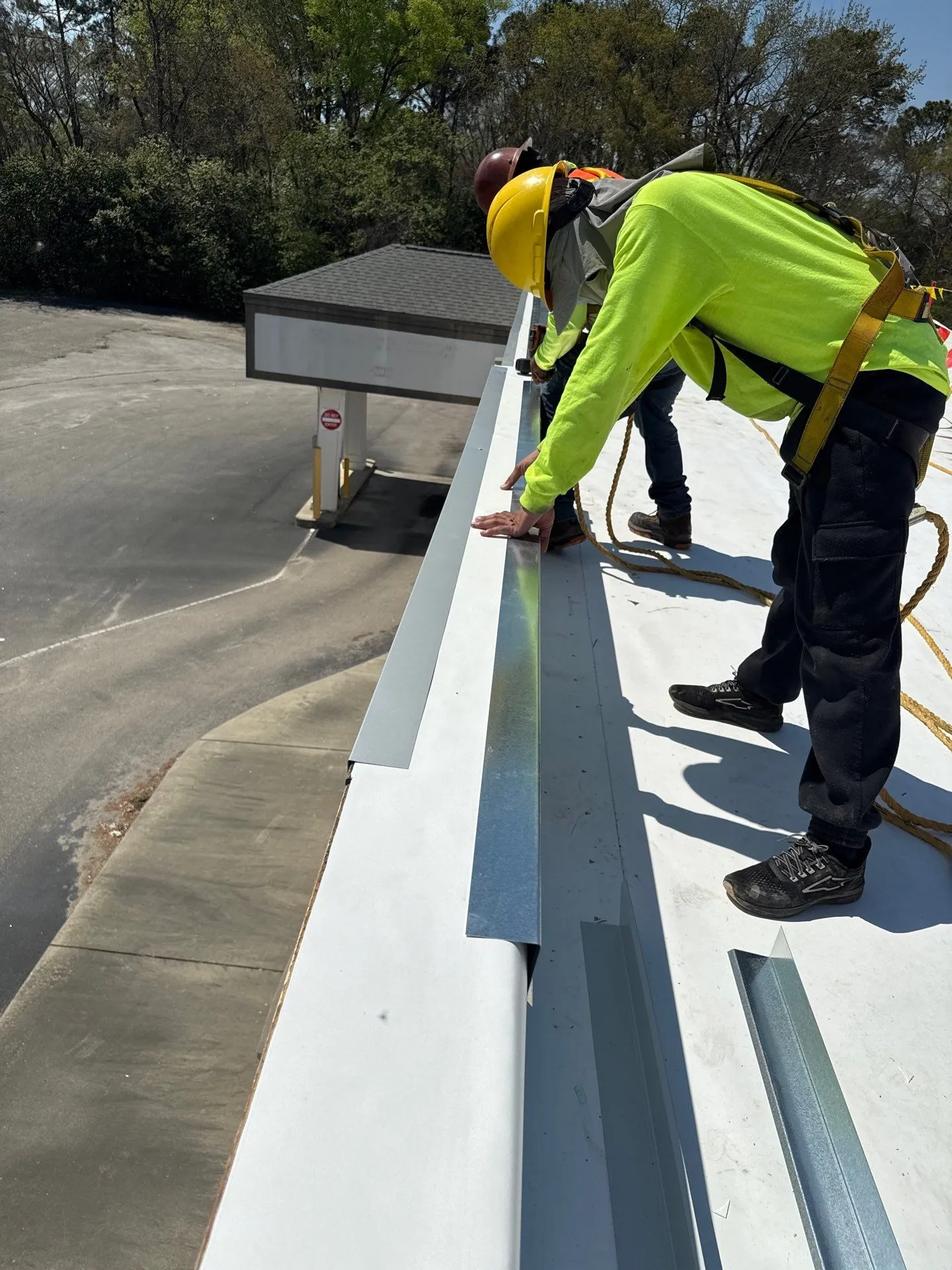
Custom-designed box gutter systems, half-round, and K-style systems for property owners, asset managers, and facility teams across the Charlotte metro. Custom-made for your building in commercial-grade materials, integrated with your roof drainage, and backed by a written workmanship warranty.
Commercial gutters are not residential gutters in a larger size. They are part of the water management system that protects your building's foundation, fascia, soffit, and tenants from the volumes of water Charlotte's afternoon thunderstorms actually produce. We size them correctly, build them to your building's specifications in heavier-gauge materials, integrate them with scuppers and internal roof drainage, and maintain them under contract for property managers who would rather not chase a leak through a tenant's office. We are family owned and locally operated, and we have been part of the Charlotte metro communities we serve for years.
Trust signals near the hero:
A commercial gutter system has one job: move the volume of water coming off your roof safely away from the building before it touches anything that can rot, corrode, stain, settle, or flood. Done correctly, the system is invisible. Done poorly, you discover it through fascia rot, foundation cracking, slab heaving, walkway icing, basement intrusion, parapet staining, soffit damage, or the worst version, a tenant call about water coming through a ceiling tile.
The cost of getting it wrong is rarely the gutter itself. It is the rot, the foundation work, the tenant relations, and the insurance claim that follow when undersized or failed gutters overflow during a Charlotte thunderstorm. We size, install, and maintain commercial gutters with that downstream cost in mind, not just the linear-foot quote.
We custom design and install three commercial gutter system types: box gutter systems, half-round, and K-style. Each system is custom-made to fit the building's actual conditions rather than assembled from stock lengths cut and joined every 10 feet. Conductor heads, oversize downspouts, scupper integration with low-slope roof drainage, and heavy-gauge hangers sized for commercial loads are part of every system scope.
Box gutter systems. Square-profile gutters sized for high-volume drainage, used on industrial buildings, large warehouses, churches, and commercial properties where K-style or half-round will not handle the rainfall load. Available externally mounted or as built-in and internal box gutters integrated into the building structure or roof edge. Built-in gutter work is specialized; it requires coordination with the roofing assembly, which we handle in-scope.
Half-round systems. Used on architectural commercial, hospitality, mixed-use, and historic Charlotte buildings. Smoother water flow than K-style, easier to clean, and visually distinct. Available in 6-inch and 8-inch profiles depending on water volume and building scale.
K-style systems. The most common Charlotte commercial gutter profile. We install 6-inch and 7-inch K-style for buildings where rainfall volume exceeds residential 5-inch capacity, which is most commercial properties. The 7-inch profile is standard on warehouses, large retail, and any building with significant roof area draining into a single run.
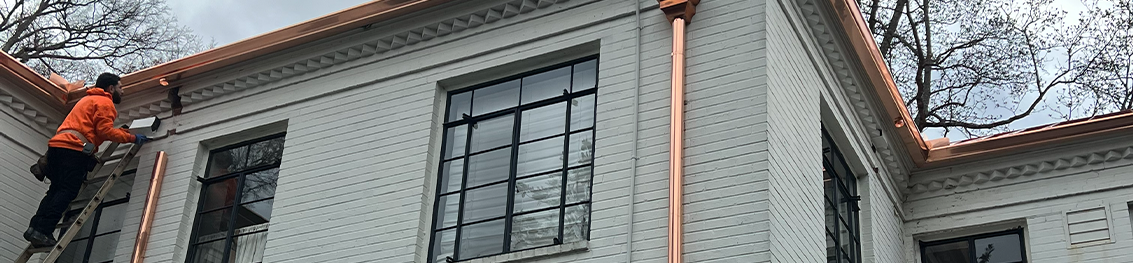
Materials we install. Heavy-gauge aluminum (.032 and .040) for most commercial work. Galvalume and painted steel for industrial and high-load applications. Copper for architectural, historic, and premium commercial properties. Stainless steel and other specialty materials available on specification.
Most commercial gutter problems we diagnose start with sizing, not workmanship. The original installer used residential 5-inch K-style on a building producing twice that capacity in a Charlotte thunderstorm, and the system has been overflowing every August for the past 12 years.
Commercial gutter sizing is a calculation. The variables are roof area draining into the gutter, roof slope, expected rainfall intensity for the local climate, downspout count and size, and the gutter profile. Charlotte's design rainfall intensity for a 5-minute, 10-year storm is roughly 7.5 inches per hour. That is the number a correctly sized commercial gutter has to handle without overflowing.
When we scope a gutter replacement, we run the numbers and recommend the profile, gauge, and downspout configuration that handles your roof area at Charlotte's rainfall rate with margin. If the existing system is overflowing, we tell you whether it is a debris problem, a slope problem, an undersizing problem, or a downspout problem, and we recommend the actual fix rather than replacing in kind.
On most Charlotte commercial buildings with a low-slope roof, the gutter system is half of the drainage equation. The other half is internal drains and scuppers built into the roof itself. The two work together; designing or repairing one without considering the other is how leaks happen.
We coordinate gutter work with our commercial roofing work directly because we install both. When we replace a TPO roof under GAF NDL warranty, the scupper assemblies and conductor heads tying that roof into your gutter system get inspected, replaced, or upgraded as part of the same scope. When we install or replace gutters on a building with internal roof drainage, we verify the drains are clear and functional before we hand the job back. The result is a single contractor accountable for the complete water path from roof surface to ground, not two contractors blaming each other when something leaks.
Most commercial gutter failures are predictable. These are the patterns we see most often when we walk a Charlotte commercial building for the first time.
Undersized gutters overflowing in storms. The most common single problem. Original installer used residential-spec gutters on a commercial roof, and the system overflows every heavy rain. Visible signs: fascia staining below the gutter, erosion or mulch displacement in beds underneath, water marks on parapets and walls.
Hanger and bracket failures. Commercial gutters loaded with wet pollen, oak leaves, pine needles, or ice pull away from fascia where hangers spaced for residential loads cannot handle commercial loads. Sagging gutters, separation at corners, and pulled fascia boards are the visible signs.
Sealant and seam failures at corners and outlets. Commercial gutter joints expand and contract more than residential because the runs are longer. Sealant has a real-world service life of 5 to 8 years on commercial work; it fails first at miters and downspout outlets. Slow drips and rust streaking on downspouts indicate seam failure.
Debris accumulation and biological growth. Charlotte's spring pollen, summer thunderstorm debris, and fall oak and pine debris fill commercial gutters faster than most building owners expect. Standing water in clogged gutters develops biological growth, draws insects, and accelerates corrosion of the gutter itself.
Downspout blockages. Underground tie-ins to drain systems clog with debris that washes through the gutter. The first symptom is overflow at the downspout transition during heavy rain, or water backing up into the conductor head.
Fascia and soffit damage from prolonged overflow. When gutters have been overflowing for years, the underlying fascia rots and soffit panels stain, sag, or separate. Repair of the gutter without addressing the fascia damage is incomplete work.
Internal box gutter leaks. On older buildings with built-in gutters, sealant or membrane in the gutter trough fails and water drops into the wall assembly rather than the downspout. These leaks often present as wall stains far from the actual entry point and require careful diagnosis.
Property managers running multi-building portfolios benefit from gutters being on a schedule rather than a complaint queue. Commercial gutter maintenance contracts include scheduled cleaning twice a year (typically post-pollen in spring and post-leaf in fall), seam and sealant inspection on the cleaning visit, downspout flush testing, and a written condition report after each visit.
Buildings under maintenance contracts experience fewer overflow events, longer system service life, and predictable budget impact rather than emergency repair bills after the next storm. For multi-property portfolios we use standardized condition reports across every building so your asset team can compare year over year and across properties.
Charlotte's afternoon thunderstorms produce the rainfall intensities that turn marginal gutter systems into damage events. After named storms, hail, or unusual high winds, gutters can be punctured, dented, pulled from fascia, separated at seams, or filled with debris that prevents drainage. We provide post-storm inspections that document gutter damage with photos and scope reports for insurance carriers, and we handle the repair or replacement once the claim is in motion.
We do not negotiate insurance claims with your carrier on your behalf, which crosses into public adjusting and is regulated. Your insurance carrier remains the decision-maker on coverage and amount, and your deductible remains your responsibility under the policy.
Gutters fail in ways that look like roof leaks. Roof scupper failures look like gutter overflows. Fascia damage from overflowing gutters compromises the roof edge. We do both kinds of work, on the same building, under the same project manager, which means the diagnosis is honest and the scope is integrated.
If your building needs both a gutter project and a commercial roofing project, we scope and price them together. If your gutter problem is actually a roof drainage problem, or your roof leak is actually a gutter overflow problem, we tell you which one needs the work rather than upselling the other. See our commercial roofing and our commercial roof repair for the broader water management context.
Super Roofing Company is family owned and locally operated. We have been in and part of the Charlotte metro communities we serve for years. Our office at 8811 Charlotte Highway in Fort Mill, SC is centrally positioned for the Charlotte commercial corridors we serve: SouthPark, Ballantyne, University Research Park, South End, Uptown, NoDa, Plaza Midwood, the Westinghouse Boulevard / I-77 industrial belt, and the I-485 outer ring including Concord, Huntersville, Matthews, and Pineville. We work York and Lancaster counties on the South Carolina side.
Family ownership matters on commercial gutter work in particular because gutters are easy to undersell at install and easy to walk away from after the check clears. The contractor who answers your call when something fails three years out is the one who actually stands behind the work.
Have a building with gutter problems or a portfolio that needs eyes on it? Request a Comprehensive Gutter Inspection. A project manager responds within one business day to schedule the visit.
Commercial gutter pricing is not a flat per-linear-foot number. The variables include profile (K-style, half-round, box, built-in), gauge and material, hanger type and spacing, downspout count and size, conductor head and scupper integration, building height and access, fascia condition, and whether wood repair behind failed gutter sections is part of the scope.
A reasonable framing for capital planning purposes: K-style 6-inch or 7-inch aluminum replacement on an accessible commercial building falls in the mid double digits per linear foot, all-in. Half-round, copper, box gutters, and built-in gutter work runs higher depending on materials and complexity. Targeted repairs are scoped per project and depend heavily on whether fascia and soffit damage are part of the work.
The lifecycle math is the conversation worth having. A correctly sized and maintained commercial gutter system can last 25 to 40 years in the Charlotte climate. The same building installed cheap and never maintained will be replacing components in year 8. We will run the numbers honestly with you.
Tell us about your building. A project manager responds within one business day with next steps.
Built on Excellence. Backed by CertainTeed's ShingleMasterTM PREMIER Certification.