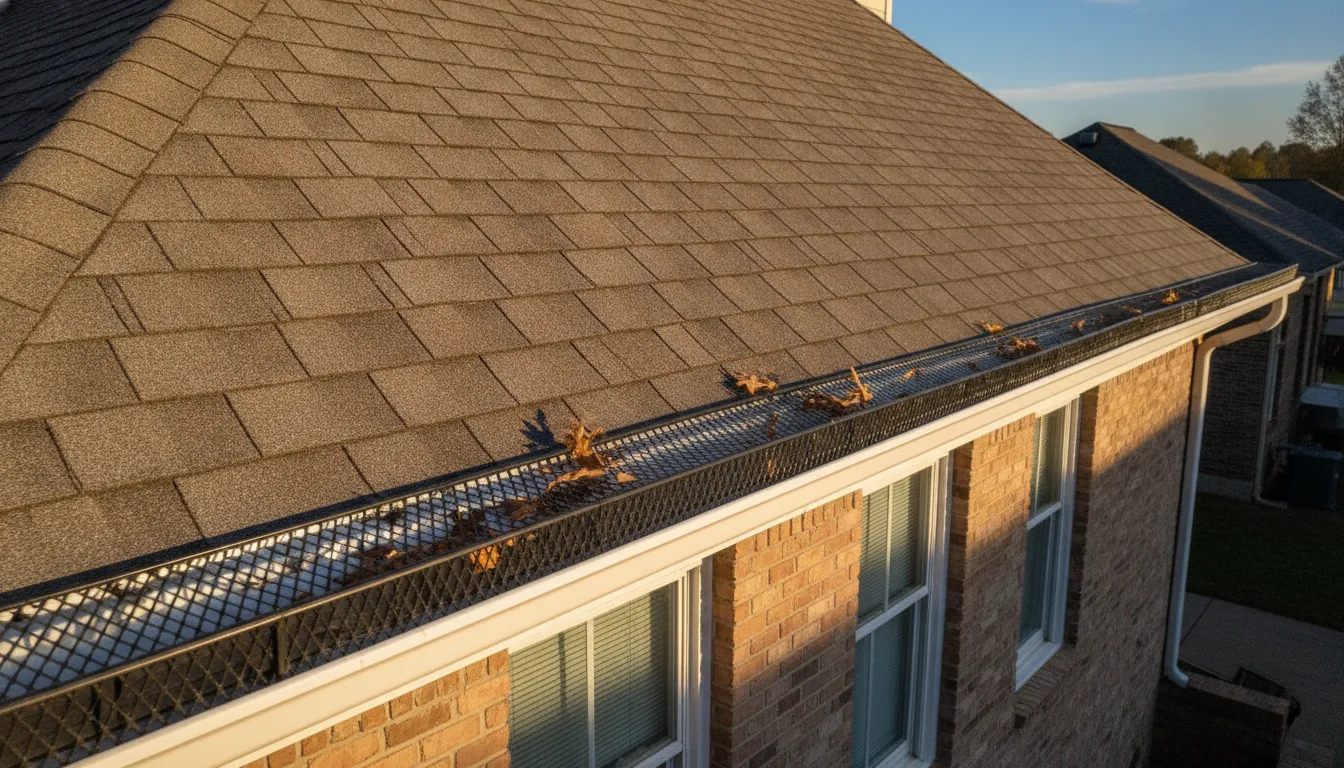
Gutter guard cost is not one number you can look up for a Charlotte-area home. Two houses on the same street can land in very different places. Footage, trees, and the condition of the gutters underneath all change the job. A useful proposal prices the work this house actually needs, not a package pulled from a national average.
Call (704) 232-7879 to Book Your Exclusive Roof Evaluation
Super Roofing Company looks at gutters as part of the roof's water path, not as a separate product sale. On a residential project we install 5-inch and 6-inch seamless aluminum gutters, place downspouts about every 35 feet, and can include guards when the home calls for them. A gutter estimate is part of every roofing quote. This guide is about the questions that change the guard number. For when a guard is a good idea at all, start with our gutter guard installation guide, then come back here to read the proposal.
The first driver is simple: how many feet of gutter the guard has to cover. A compact one-story home with two long runs is a different job from a two-story house with hips, dormers, and short pieces over every bay. Corners, end caps, and the places where a valley dumps water onto one short section all take more time than a straight run along the back of the house.
Height and access come next. A walkable first-floor eave is a simple visit. A steep roof over a porch, a pool deck, or a tight side yard in Myers Park or Eastover is not. If the crew needs extra setup to work safely, that belongs in the written scope. It should not appear later as a surprise.
Debris matters as much as footage. Charlotte yards throw different material at a gutter. Broad hardwood leaves, pine needles, seed pods, and the grit that washes off an asphalt roof do not behave the same way on a cover. A guard that looks right on a neighbor's oak-shaded ranch can be the wrong choice under pines in Ballantyne or along a wooded lot in Waxhaw. Match the opening to what actually falls on your roof. The wrong match means paying twice: once for the guard, and again for the overflow it did not stop.
The roof shape changes the math too. A valley concentrates a large roof area onto a few feet of gutter. So does a long upper roof that sheds onto a lower one. Those spots need a guard design that can take a rush of water, not just a light sprinkle of leaves. If the proposal treats every foot the same, ask why.
A guard only works if the gutter under it can carry water and hold the cover. NC State Extension's gutter guidance makes the same point. A gutter system protects the house from moisture only when it is designed and maintained. A guard or strainer can help keep debris out. It is not a substitute for a clear downspout.
Before you price a cover, look at the gutter you already have. Pulled hangers, open joints, a run that pitches the wrong way, and downspouts packed with shingle grit will still fail after a guard goes on. Fascia that has stayed wet can be soft behind the gutter. Fastening a new cover to that wood does not fix the wood.
On our visits, that check is part of the same conversation as the roof. An Exclusive Roof Inspection runs about 45 to 60 minutes with the owner or manager there. We look at the perimeter, gutters, fascia, soffit, and how water leaves the house, then explain what we found on site. If the gutter needs new hangers, a reset, or a section replaced, that repair is its own line. It is not a reason to hide a larger number inside "gutter guard cost."
Residential repairs are meant to fix the cause, not to cover it. A 1-year residential workmanship warranty applies to repair work. That is separate from any product literature that comes with a guard, and separate from the workmanship warranty on a full roof system. Ask which promise applies to which line on the proposal.
If the gutters themselves are at the end of their life, the honest comparison may be a new seamless run rather than a cover on a tired one. The cost of the gutter is a different question from the cost of the guard. We keep those scopes apart so you can see both.
You will see three broad ideas in the market. A screen or mesh sits over the opening and lets water through while holding back larger leaves. A reverse-curve or surface-tension cover sends water into a narrow slot and sheds debris off the top. A brush or foam insert fills the trough. Each one handles Charlotte debris differently, and each one asks something different of the gutter beneath it.
Screens are often the simpler install on a sound K-style gutter, but fine needles and roof grit can sit on top or pass through, depending on the opening. Surface-tension covers usually take more fabrication at corners and valleys, which is where the price moves. Inserts can look inexpensive per foot and still be a poor match if they hold damp debris against the gutter.
We do not publish a per-foot guard price, and a national range will not tell you what this house should cost. Compare the design named in the proposal. Look at the product, the material, the corner and valley details, and whether the 5-inch or 6-inch gutter is kept, reset, or replaced. If two proposals name different products, they are not the same bid even when the footage matches.
| Comparison point | Price driver | Ask for this in writing |
|---|---|---|
| Footage and roof shape | Corners and valley outlets take more time than a long straight run | Measured footage, plus a note on valleys and lower roofs |
| Guard design | Screens, surface-tension covers, and inserts are different products | Manufacturer, model, material, and corner finish |
| Gutter and fascia condition | Hangers, a reset, or a new run can exceed the guard itself | Separate lines for the guard, gutter work, and wood repair |
| Access | Story height, steep roofs, and tight side yards add setup time | Whether unusual access is included or excluded |
| Water leaving the house | A guard does not fix a downspout that dumps water at the foundation | Who handles downspouts, and where water is released |
A guard does not change how much water the roof produces. It only changes what else tries to ride into the gutter with that water. The City of Charlotte Stormwater Design Manual gives the rainfall intensities used for local drainage design. For a 5-minute storm, Table 2-7 lists 7.03 inches per hour at the 10-year recurrence. That figure is for site drainage engineering, not a quote for your gutters. It does explain why an undersized run overflows in a summer thunderstorm, even when it looks fine on a dry Saturday.
Roofs are treated as hard surfaces in that same manual, with a high runoff coefficient. Water leaves shingles quickly. If a valley already overwhelms a 5-inch gutter, a cover will not create capacity that was never there. Sometimes the right spend is a larger residential gutter, an added downspout, or both, and the guard is secondary. Sometimes the gutter is already the right size and the guard is the piece that keeps leaves from becoming the clog.
That is also why we talk about downspouts, not only the trough. NC State Extension prefers a drain that releases downspout water well away from the house. It also warns against splash blocks that drop water at the foundation. If your proposal prices a guard and says nothing about where the water goes after the downspout, the scope is incomplete. Our roof drainage maintenance notes cover the ongoing care of gutters, valleys, and downspouts once the system is right.
Lay the proposals next to each other and check the same five items. Measured footage. Named product. What happens at corners and valleys. What gutter or fascia work is included, and what is not. Who comes back if a section overflows after the first hard rain.
A lower line that excludes hanger repairs, downspout flushing, and valley pieces is not a lower price. It is a smaller job. A higher line that replaces a failing run, resets the pitch, and then covers it may be the one that actually keeps water off the fascia. Fascia that stays wet is its own repair later. If that board is already soft, read our notes on roof fascia replacement before you approve a cover fastened to it.
Ask each contractor to say, in a sentence, what they think is causing the current overflow. One answer might be "you need guards." Another might be "the back run pitches toward the corner and the downspout is packed with grit." The second answer tells you more than the dollar gap. We would rather explain that on the roof than win a race to a thin scope.
Financing can be discussed for exterior work when you want to spread a larger drainage project out. It does not change which scope is the right one. Get the scope right first.
You should be able to read the proposal without a salesperson in the room. These are the lines that make a gutter guard cost comparable from one company to the next:
If a line says "gutter guards, complete" and nothing else, you cannot compare it to a proposal that itemizes the repairs. Ask for the breakdown before you choose.
A short list is enough. You are not trying to become an installer. You are trying to see whether the price matches the house.
The last question matters. A guard can cut down how often you are on a ladder. It does not retire the gutter. NC State Extension still recommends a yearly look, and another look after major weather, to confirm the system is clear and working. Plan on that even after a careful install. We would rather say so up front than imply a cover means you never think about drainage again.
Call Today to Speak with a Super Roofing Representative
Calculators multiply a national per-foot guess by a rough footage estimate. They cannot see your valleys, the pitch of the existing gutter, pine needles versus oak leaves, or soft fascia behind the trough. Those are the items that move a real proposal. Use a calculator only as a reminder to get the house measured.
Not by itself. A higher number might be a more fabricated cover, or it might be honest gutter and fascia repairs that a thinner bid left out. Compare the named product and the repair lines. If those match and one price is still far apart, then ask what the extra dollars buy.
Often that is the cleanest time, because the eave, drip edge, and gutter are already part of the visit. Super Roofing includes a gutter estimate with every roofing quote, and guards are optional on our residential 5-inch and 6-inch seamless aluminum systems. It is still a separate decision. Do not add a cover to a gutter that needs to be replaced.
Only if the gutter and downspouts were already large enough and clear enough for that roof. Charlotte's design rainfall for a short, intense storm is high. A cover can hold back larger leaves. Fine needles and roof grit can still pass through or sit on top, and a downspout can still clog. A cover does not add capacity. If the bare gutter overflows when it is clean, fix the size, pitch, or downspouts first.
No. They change the kind of maintenance. You may deal with debris on top of a cover instead of a packed trough, and downspouts can still clog with grit. Inspect yearly and after major storms, and make sure water still leaves the house well away from the foundation.
If you want the number tied to this house, the next step is a look at the roof edge, the gutters, and how water leaves the property. Super Roofing Company serves greater Charlotte homeowners who would rather see the findings than shop a thin bid. Call (704) 232-7879 and ask for an Exclusive Roof Inspection. We will tell you whether a guard belongs on the quote, what has to be repaired first, and what each line is for.
Bring the questions above to the visit. A clear scope is the only gutter guard cost worth comparing.