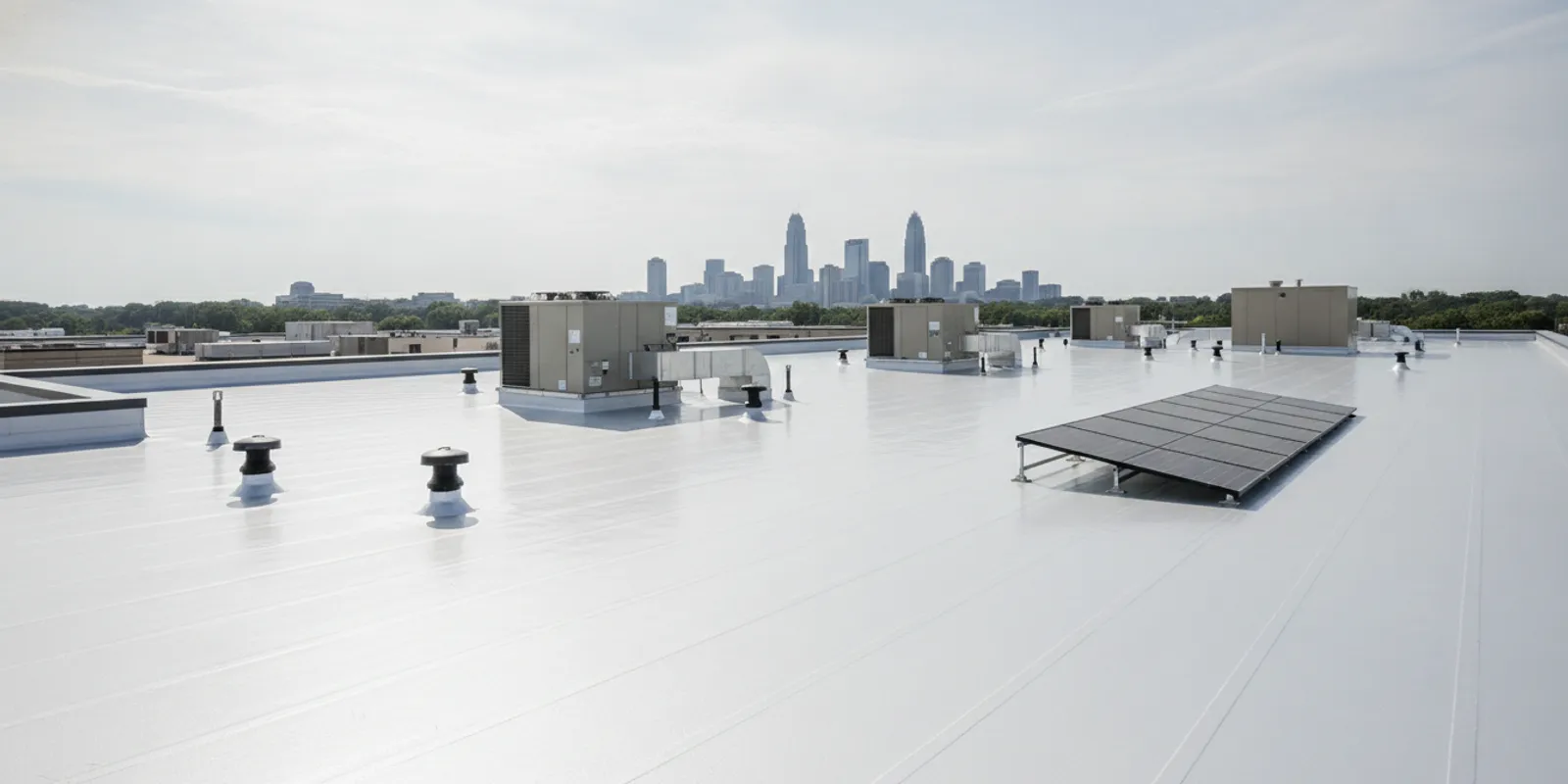
A commercial roof is the whole assembly, not a membrane name on a brochure. The deck, insulation, cover board, membrane or other covering, flashing, drains, and the equipment sitting on top all have to work together. Picking TPO because a neighboring building has TPO skips the question that actually matters: what is on this building now, and what does this building need the roof to do?
For a Charlotte-area property, start with the existing roof, how it drains, how the building is used, and how long you expect to keep it. This guide is the list of decisions that turn those facts into a written scope.
Call Today to Book Your Exclusive Roof Evaluation
Read the roof as layers, not as a product.
A proposal that names only the membrane and not the layers under it is incomplete. The service overview is on commercial roofing.
On low-slope commercial buildings in this market, the comparison is usually among TPO, PVC, modified bitumen, and a coating over a roof that is still a candidate for one. EPDM is common on older buildings. Super Roofing services existing EPDM and does not install it as a new system.
TPO and PVC are both single-ply membranes, and they are not the same product. See TPO roofs and TPO compared with EPDM for the practical differences. Modified bitumen is a different installation, often with different flashing details. A coating is a maintenance or restoration step, not a new roof, and it only belongs on a roof whose deck and membrane can take it.
Match the system to the building. A kitchen with grease, a warehouse with rooftop units, and an office with light foot traffic do not put the same demands on the membrane.
Ask four questions before anyone recommends a product:
A system that fits the neighbor and not these answers is the wrong system.
An evaluation should say what was looked at and what was not. Core items are the membrane condition, seams and flashings, drains and slope, obvious wet insulation if it can be checked without destructive testing, rooftop equipment curbs, and any active leak tied to a location inside. Ask what is included before the visit. A look from the hatch is not the same as a written survey of every plane.
How that visit is set up is on commercial roof inspection.
These are different projects. A repair fixes a defined failure. A maintenance plan records condition on a schedule and catches small failures before they spread. A coating can extend a roof that is still sound. A replacement rebuilds the assembly when repair will not hold for the time the owner needs.
The proposal should say which of the four this is, and why the others were set aside. One leak is not a replacement order. A roof with wet insulation across several sections is not a coating candidate. Ongoing care after the project is described on commercial maintenance. When the assembly itself has to come off, see commercial roof replacement.
Line the scopes up before you line up the prices.
A lower total that leaves out tear-off or drain work is not a lower price for the same job.
Say which areas of the building can tolerate noise, odor, and a closed entrance, and which cannot. Kitchens, exam rooms, and server spaces change the plan. Ask how the crew protects openings, where materials are staged, and who is called if the weather turns while the roof is open. Occupied buildings need a sequence, not just a start date.
Manufacturer coverage and workmanship coverage are separate. Ask which product warranty is available for the system being installed, what it requires at installation, how long the workmanship warranty runs, and what maintenance keeps either one in force. The way those layers are described is on the warranty page. Read the documents for this building. Do not assume a warranty covers interior damage or a leak from a detail that was excluded.
Price the scope you actually compared, then ask what is allowance and what is firm. Wet insulation, deck repair, and unforeseen curbs are the usual allowances. A schedule should name how weather and material lead times move the date. Treat the date as a plan.
Storms, hail, and heavy rain show up in how a low-slope roof drains and how flashings hold. Ponding, clogged drains, and open seams matter more here than a product slogan. Note the age of the roof and any earlier coatings or overlays before you add another layer. An overlay over a wet or failing roof stores the problem.
A warehouse with two rooftop units and chronic ponding at one drain is not the same decision as a retail building with a sound membrane and a failed pipe flashing. The first may need drainage work and a defined repair, or a replacement if the assembly is at the end of its life. The second may be a flashing repair and a maintenance plan. The membrane brand does not decide that. The condition and the scope do.
Get the existing roof looked at and ask for a written scope that names the system, the tear-off decision, the drainage work, and the warranty. Compare that scope with any other quote on the same items. For site safety expectations during the work, OSHA publishes the workplace rules contractors are expected to follow. It does not design the roof.